

A decent e-bike costs between $1,000 and $2,000 in 2026. That is the honest one-sentence answer, and it is the number most shoppers eventually land on after a week of tab-hopping.
But the sticker price is the least interesting number on the page. Two bikes can both say $1,499 and be completely different machines — one with a 960Wh battery and hydraulic brakes, the other with a 480Wh pack and mechanical discs hiding behind a glossy product photo.
This guide breaks down what e-bikes actually cost in 2026, what each price tier really buys, where the money goes inside the bike, and the costs that never appear in the cart.
The Short Answer: Five Price Tiers
| Tier | Typical price | What you get | What you give up |
|---|---|---|---|
| Budget | Under $700 | 350–500W hub motor, 7–10Ah battery, mechanical disc brakes, steel or low-grade alloy frame | Real range, brake performance, parts availability, any meaningful warranty |
| Entry | $700 – $1,200 | 500W hub motor, 10–15Ah battery, entry Shimano drivetrain, mechanical or basic hydraulic discs | Battery capacity, component quality, dealer support |
| Mid-range | $1,200 – $2,000 | 750W hub motor or entry mid-drive, 15–20Ah battery, hydraulic discs, name-brand cells, 7-speed drivetrain | Weight, and the polish you get from brands charging twice as much |
| Premium | $2,000 – $3,500 | Mid-drive motor, torque sensor, 20Ah+, air fork, brand-name brakes and drivetrain | Very little, except money |
| High-end | $3,500+ | Cargo and performance platforms, dual batteries, premium suspension, dealer service networks | Nothing — but the returns flatten fast above $3,500 |
Most American buyers land in the $1,200–$2,000 band, and that is where the competition is fiercest. It is also where the spec sheet matters most, because every brand is promising the same thing at the same price.
Why Two $1,500 E-Bikes Can Be Completely Different Bikes
The battery sets the floor
The battery is the single most expensive component on an e-bike — often 30–40% of the manufacturing cost. It is also the part shoppers understand least.
A 48V pack is sold in amp-hours (Ah), but amp-hours alone tell you nothing. Multiply voltage by amp-hours to get watt-hours (Wh), which is the actual energy stored:
- 48V × 10Ah = 480Wh
- 48V × 15Ah = 720Wh
- 48V × 20Ah = 960Wh
A 960Wh pack holds twice the energy of a 480Wh pack. That means roughly twice the range, twice the cell cost, and twice the weight. When one $1,499 bike claims 40 miles and another claims 80, the battery is usually the entire explanation — not marketing magic.
Cell quality matters just as much as capacity. Packs built from Samsung, LG, Panasonic or similar 21700 cells cost more and behave more predictably over time than unbranded cells of the same nominal capacity.
The motor and controller set the ceiling
A 750W hub motor is the American commuter standard: enough torque for hills and a loaded rear rack, simple to service, and cheap to replace. Mid-drive motors cost significantly more but climb better and feel more like a bicycle, because they drive through the gears.
What the spec sheet rarely tells you is controller quality. A cheap controller paired with a good motor produces jerky power delivery and short component life. This is the invisible corner that gets cut first.
Brakes are where budget bikes get scary
Mechanical disc brakes are fine on a 35 lb bicycle. On a 70 lb e-bike carrying a rider and groceries down a wet hill, they are marginal.
Hydraulic disc brakes cost more, and on an e-bike they are not a luxury — they are the difference between stopping and hoping. If you are comparing two bikes at the same price and only one has hydraulics, that tells you something about where the other one saved money.
Sensors change how the bike feels
A cadence sensor detects that the pedals are turning and switches the motor on. It is cheap, and it feels like an on/off switch.
A torque sensor measures how hard you are pushing and matches assistance to your effort. It costs more and feels natural — like the bike is reading your legs rather than guessing. We explain the difference in more detail in our guide to pedal assist levels.
Neither is "wrong." But a torque sensor is a genuine cost driver, and its presence explains a meaningful part of a price gap.
Certification is a real cost — and a real signal
Testing to UL 2849, the U.S. safety standard for e-bike electrical systems, costs real money and takes real time. Testing to a national standard with a recognized laboratory costs more still.
That cost shows up in the price of the bike. It also shows up in whether the bike is legal to sell in jurisdictions that require it — New York City, for example, requires UL 2849 compliance for e-bikes sold or rented there.
When you compare a $899 bike to a $1,399 bike, part of that $500 is certification. Ask any seller for the test report before you assume it exists.
Do the Battery Math Before You Compare Anything
Price per watt-hour is the most useful number in e-bike shopping, and almost nobody calculates it.
| Pack | Energy | If the bike costs $1,299 | If the bike costs $1,599 |
|---|---|---|---|
| 48V 10Ah | 480Wh | $2.71 per Wh | $3.33 per Wh |
| 48V 15Ah | 720Wh | $1.80 per Wh | $2.22 per Wh |
| 48V 20Ah | 960Wh | $1.35 per Wh | $1.67 per Wh |
Lower is better. This is not a perfect metric — it ignores motor, brakes and frame — but it instantly exposes bikes that charge a premium for a small battery.
A $1,299 bike with a 960Wh pack is a fundamentally better value than a $1,199 bike with a 480Wh pack, even though the sticker price is higher.
The Costs That Don't Show Up in the Cart
Budget for these before you decide the bike is affordable.
1. Assembly and setup. Most direct-to-consumer e-bikes arrive 85% assembled. You install the front wheel, handlebar, pedals and light. That is 20–30 minutes if you are comfortable with tools, or $75–$150 at a local shop if you are not. Have a shop check the brakes and torque the bolts either way.
2. The accessory tax. A helmet, a lock that is actually rated for a $1,500 bike, lights if the bike lacks them, and a rack or basket add $150–$300. Skipping this step is how people end up with a stolen bike in month two.
3. Consumables. Tires, brake pads, chains and cables wear faster on a heavier, faster machine. Plan on $100–$200 a year for a commuter doing 2,000–3,000 miles, more if you ride in wet conditions.
4. Battery replacement. Every pack has a finite life. Budget for one replacement over five years. On most e-bikes that runs 25–40% of what you originally paid — which is another reason the battery, not the frame, should drive your purchase decision.
5. Insurance and storage. Renters and homeowners policies often cover e-bikes partially, but a dedicated policy or a rider may be worth it in high-theft cities. Add $50–$150 a year if you go that route.
What It Costs to Run: Pennies vs Dollars
Charging is almost free. A 960Wh pack holds 0.96 kWh, and at a U.S. average residential rate of roughly 17 cents per kWh, a full charge costs about 16 cents.
If that pack delivers even 30 miles of real-world range, you are paying roughly half a cent per mile in electricity. At 50 miles, it is a third of a cent.
Compare that to the all-in cost of owning and driving a new car, which AAA's annual driving-cost study puts at roughly 70 cents per mile once you include fuel, insurance, depreciation and maintenance.
That comparison only holds for trips an e-bike can actually replace — the two-mile coffee run, the four-mile commute. Nobody is arguing you should tow a couch on one. But for the short trips that make up most of a household's miles, the economics are not close.
What $1,199–$1,599 Actually Buys in 2026
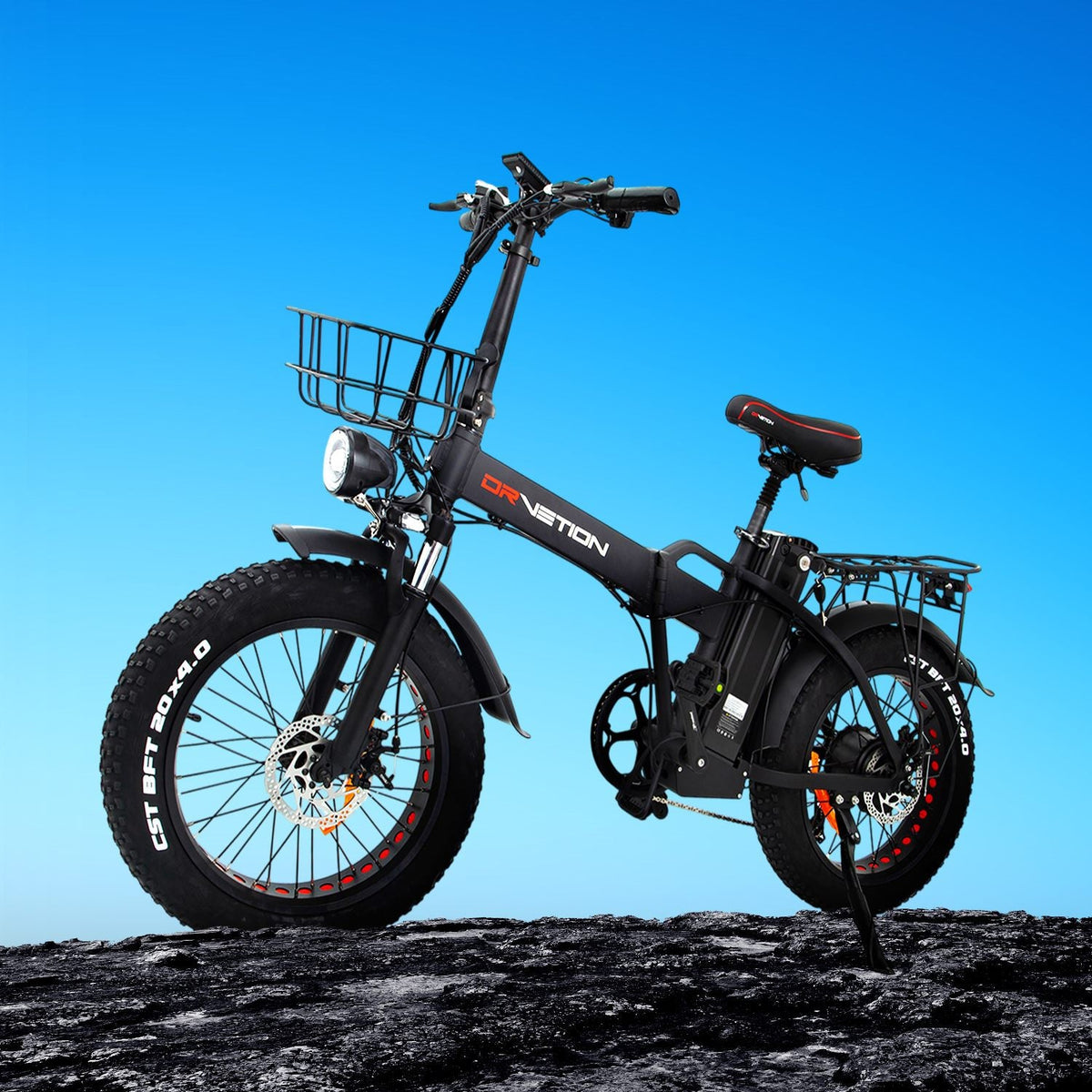
Here is a real example of the mid-range tier, from a brand that sells folding fat-tire e-bikes in exactly this band. Full specs for each model are in the product guide.
| Model | Price | Battery options | Motor | Frame |
|---|---|---|---|---|
| CT20 | $1,199 | 48V 10/15/20Ah | 750W hub | Step-through folding |
| BT20 | $1,199 | 48V 10/15/20Ah | 750W hub | Step-over folding |
| CT20 PRO | $1,299 | 48V 10/15/20Ah | 750W hub | Step-through, front basket + rear rack |
| AT20 PRO | $1,299 | 48V 10/15/20Ah | 750W hub | Step-over folding, front + rear racks |
| CT20 PRO MAX | $1,499 | 48V 15/20Ah | 750W hub | Step-through, fat tires, basket + rack |
| AT20 PRO MAX | $1,499 | 48V 15/20Ah | 750W hub | Step-over folding, rear platform |
| CTR26 | $1,499 | 48V 10/15/20Ah | 750W hub | Step-through, 26 × 4.0 tires |
At this price you should be getting a 750W motor, a pack that scales to 960Wh, hydraulic brakes on the upper models, name-brand cells and a Shimano drivetrain. If a bike in this band is missing any of those, the price is not the deal it looks like.
Five Ways Shoppers Overpay
1. Buying watts instead of watt-hours. A 1,000W motor paired with a 480Wh battery has less usable range than a 750W motor with 960Wh. Motor wattage is the headline; battery capacity is the product.
2. Ignoring the replacement battery price. A cheap bike with a $600 proprietary pack is not cheap. Ask what a replacement costs before you buy.
3. Paying for 28 mph you cannot legally use. In most states, Class 3 speeds come with restrictions — helmet requirements, age limits, and bans from certain paths and trails. Paying a premium for speed you will not ride is common and avoidable.
4. Buying the bike, then renting the accessories. Factor $150–$300 into your budget from the start. Helmets and locks bought in a panic at full retail are the most expensive version of both.
5. Buying too much bike for the ride. A 70 lb fat-tire folder is the wrong bike for someone who needs to carry it up three flights of stairs daily. The best-value e-bike is the one that fits the trip you actually take.
Frequently Asked Questions
Is $1,000 enough for a good e-bike?
Usually not for a new one. At $1,000 you are at the top of the entry tier: expect a 500–750W hub motor, a 10–15Ah battery, and mechanical or basic hydraulic brakes. It can be a perfectly good commuter, but you will feel the compromises in brakes and battery capacity within a year.
Do e-bikes cost more to maintain than regular bikes?
Yes, roughly 1.5–2×. The mechanical parts wear faster because the bike is heavier and faster, and there are electrical components that can fail. Budget $100–$200 a year for a commuter, plus one battery replacement over the life of the bike.
How long does an e-bike battery last?
Most quality packs are rated for 500–1,000 full charge cycles before capacity drops to about 80%. For a daily commuter, that is typically three to five years. Charging between 20% and 80%, storing at room temperature and avoiding deep discharges all extend that window — we cover the details in our guide to e-bike battery care.
Are cheap e-bikes safe?
The electrical system is the risk. Budget bikes sometimes use uncertified batteries and chargers, which is the root cause of most e-bike fires. Look for a UL 2849 test report from a recognized laboratory, and never charge a pack you cannot trace to a known cell manufacturer.
Can I finance an e-bike?
Yes. Most direct-to-consumer brands offer installment options at checkout — Shop Pay Installments, Affirm and Klarna are common. It is worth comparing the total cost against paying cash, since some plans carry interest.
The Bottom Line
In 2026, $1,200–$2,000 buys a genuinely good e-bike: 750W of assist, a battery that scales past 900Wh, hydraulic brakes, and components a local shop can service. Below $1,000, you are buying a bike with visible and invisible compromises. Above $2,500, you are buying refinement rather than capability. The number that matters is not the sticker price — it is price per watt-hour, brake quality, and whether the seller will show you a test report.
Comparing models? See how the Drvetion lineup stacks up side by side, or read what actually separates the CT20, CT20 PRO and AT20 PRO.
Prices shown are the Drvetion U.S. retail prices as of November 2026 and exclude tax and shipping. Range and weight figures vary by configuration — check the individual product page for the model you are considering.


Share:
Pedal Assist Levels Explained: What Level 0, 1, 2 and 3 Actually Do